
The Art of Keeping the Doors Open
Oriel Q Gallery Fund Raising Auction 2026
12 September – 3 October 2026
There is something wonderfully democratic about an art auction before the auctioneer has done his damage.
For a few weeks the walls are full, the prices remain uncertain, and a small painting by an artist one has never encountered before may demand more attention than the supposedly important work hanging beside it.
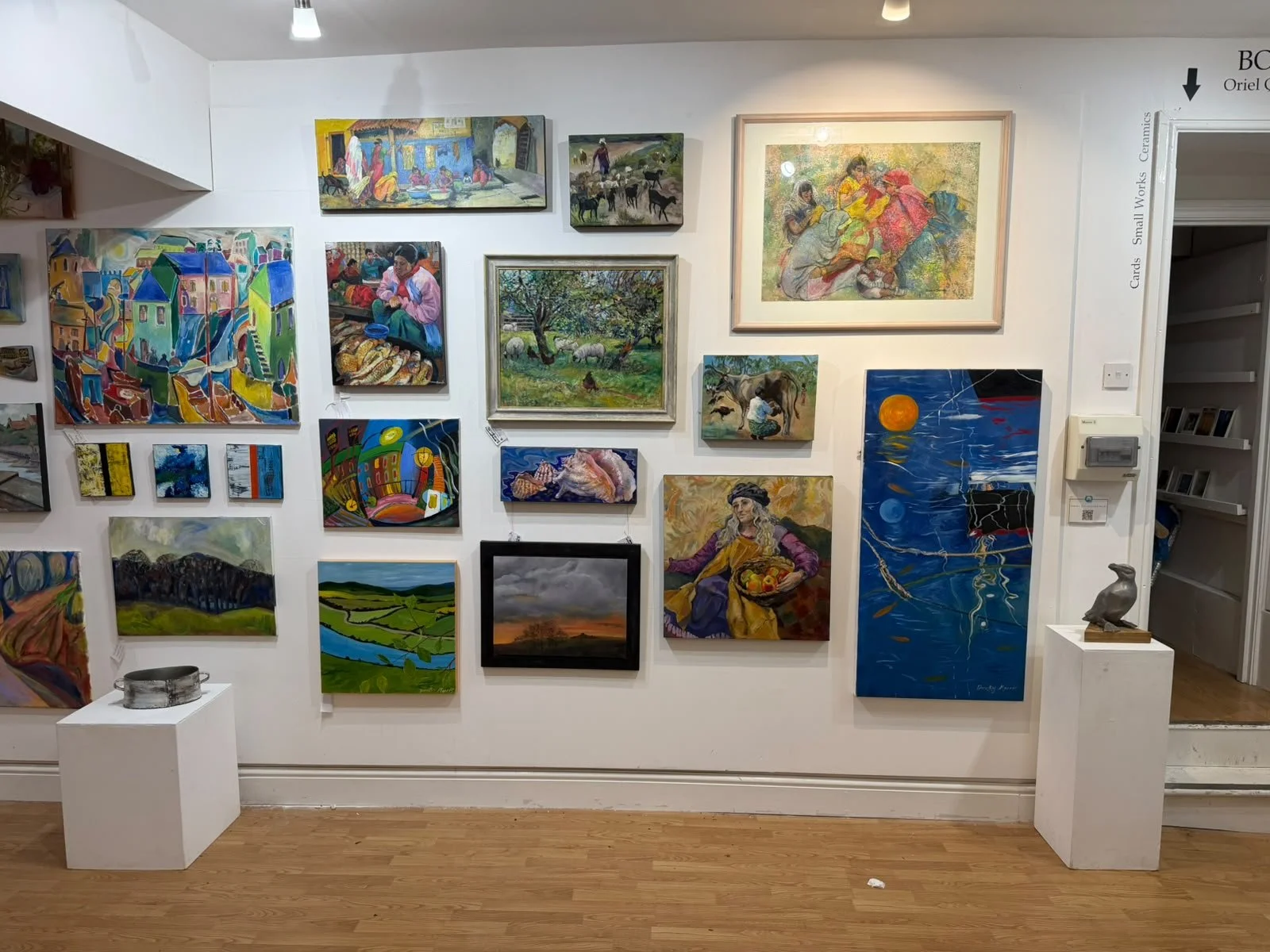
Oriel Q's annual Fund Raising Auction has always had something of this atmosphere. It is part exhibition, part treasure hunt and part act of collective survival.
And survival matters here.
Oriel Q receives no regular public funding. It exists because artists exhibit here, volunteers give their time, visitors buy work and, once a year, an extraordinary assortment of paintings, prints, sculpture, ceramics and other objects arrives in Narberth for this auction.
This year's edition contains 89 lots, from local, national and international artists, and is perhaps one of the most intriguing Oriel Q has assembled.
The starting prices are deliberately seductive. They should not be mistaken for valuations. Some artists have offered work at unusually low starting figures precisely because this is a fundraiser. A bid of £50 does not mean that a painting is worth £50; it means somebody has to begin the argument.
And there are plenty of arguments worth beginning.
Hilary Bryanston's carved mahogany works are among the first things to disturb the comfortable category of "painting". The Cat and The Cairn, The Machinery and Six Visitors from The Black Mountain occupy a territory somewhere between painting, carving, object and private mythology. They have the satisfying strangeness of things that seem to have existed before one encountered them.
Eric Windale's Buzzard and Razorbill provide another kind of physical presence. These are objects one wants to walk around rather than simply stand in front of — a useful reminder, in an exhibition dominated inevitably by walls, that sculpture requires us to move.
Landscape, unsurprisingly in West Wales, is everywhere.
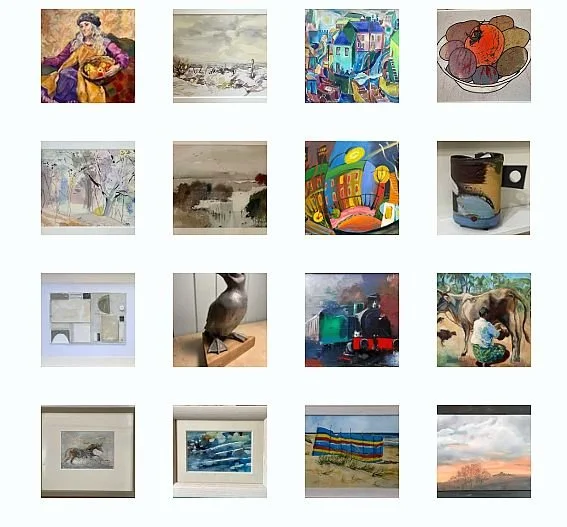
Peter Rossiter's Tenby, Road through Trees and Preseli View demonstrate how little a landscape needs to explain itself when the painter understands atmosphere. The familiar becomes less topographical and more psychological: places remembered rather than merely recorded.
Dorothy Morris appears several times in the auction, shortly after her remarkable exhibition The Stones Cry Out occupied these same rooms. Her large Towy River paintings bring a very different energy, while Orphan and Reflective remind us of an artist for whom the human consequences of history are never far from the surface.
Julie Rising's Moroccan Mystique and Underworld push further into the ambiguous pleasures of mixed media, where surfaces accumulate, conceal and reveal. They are works that reward the viewer who is prepared to look for longer than the customary gallery seven seconds.
Susan Sands, meanwhile, has enough work here to constitute almost an exhibition within the exhibition.
Her subjects travel widely: Apple Girl, Sewing Cooperative, Fish Market Imphal, Goatherder, School Milk – Tamil Nadu, Study from Ajanta Mural, alongside Pembrokeshire landscapes and animals. What holds them together is not geography but attention. Sands looks at people and places with the curiosity of somebody who has not yet decided that the world is familiar.
Jacob Buckland's Woodland, Trees and River Wye occupy another territory altogether, where landscape ceases to be description and becomes construction: wood, paint, drawing and remembered place assembled into objects rather than simply views.
Nearby, the four works by Tenby artist Martin White demonstrate the opposite virtue: economy.
White does not need spectacle. A figure, a bowl, a few objects on a table: looking is enough. There is a quiet assurance to these works which becomes increasingly attractive in a room containing nearly ninety competitors for one's attention.
The three-dimensional works provide useful interruptions. Peter Bodenham's ceramic vessel and handled bowl possess that peculiar combination of usefulness and uselessness that good ceramics have always enjoyed: one could theoretically use them, although possession would probably make one far too protective.
Elsewhere Alec Lewis, Rosemary Graham, Philippa Sibert, Geoff Yeomans and Andrea Kelland demonstrate the sheer variety that an auction of this sort permits. Nobody has attempted to impose a curatorial thesis upon the room, and thank goodness for that. The connections are accidental, temporary and therefore often more interesting.
Lee John Phillips' prints from The Shed Project, for example, turn the apparently mundane inventory of hooks, clips and plumbing fittings into something obsessive and strangely beautiful. Classification becomes drawing; drawing becomes archaeology.
Raphaelle Fieldhouse brings another shift in register. Squircle / Sgwach and Ambidexterous 2 are joined by the collaboration with Nick Parry, Pembrokeshire Landscape after John Knapp-Fisher, in which body paint, photography and landscape quotation collide. John Knapp-Fisher's Pembrokeshire has been looked at so often that it has almost become part of the county's visual vocabulary; here that vocabulary is mischievously relocated onto skin.
Ray Burnell's Carn Menyn II and Homecoming (From the River to the Sea) approach the Pembrokeshire landscape from another direction. In Homecoming, slate, acrylic and aged metal keys make landscape inseparable from memory and material. The coast is not simply somewhere looked at. It is something accumulated.
And then there are works one might easily overlook precisely because of their modest scale. Jan Parry's Melting Snow, for instance, asks very little space of the wall. Auctions reward the alert eye. Size, reputation and starting price are unreliable guides to what will remain in one's memory afterwards.
But perhaps the most fascinating element of this year's auction is not a single artist at all.
Thirty-seven of the 89 works have come from one private collection, entered by the collector's family. For a few weeks, part of one person's history of looking and collecting has therefore become public.
Private collections are rarely assembled according to curatorial theory. They grow slowly and personally — a painting bought because it was impossible to leave behind, another because the artist was known, another because it recalled a landscape, a person or a particular moment. Over decades these decisions accumulate until a collection becomes something rather like an accidental autobiography.
Seen among works entered directly by contemporary artists, these thirty-seven pieces give the auction an unusual texture. Pictures that have already had one life on somebody's walls sit beside works coming directly from artists' studios. One group looks backwards, perhaps, while the other is still beginning its journey.
All 89 lots in the auction operate on Oriel Q's 50/50 basis: half of the proceeds goes to the artist or owner of the work, and half goes to support the gallery.
It is a simple arrangement, but an important one. Artists and collectors have a genuine stake in the sale, while every successful bid also helps sustain an independent gallery which receives no regular public funding.
There is something pleasingly circular about it. Artists make work, collectors live with it, galleries bring the two together — and occasionally the work returns to the gallery to begin the whole process again.
Art, after all, is remarkably good at outliving our arrangements for it.
Small independent galleries are often discussed as though they were merely rooms in which pictures are sold.
They are not.
At their best they are pieces of cultural infrastructure: places where an unknown artist gets a wall, where somebody buys their first original painting, where arguments begin, friendships form, exhibitions happen that would never survive a committee meeting, and where the local and the international can occupy the same few square metres without anyone finding this peculiar.
But such places do not continue by magic.
They continue because people participate.
The cleverness of the Oriel Q auction is that participation can take several forms. An artist can enter a work. A collector can release one. A volunteer can help hang it. A visitor can walk through the door. And someone sitting at home can scan a QR code and decide that perhaps £55 is not an entirely unreasonable price for something they suddenly cannot imagine living without.
Then somebody else bids £60.
And culture, in its wonderfully untidy way, has funded itself for another few minutes.
There are bargains here, certainly. There are also serious works by established artists, curiosities, experiments, landscapes, figures, ceramics and things that stubbornly refuse easy classification.
But I would resist approaching this simply as a hunt for bargains.
Go to the gallery first if you can.
Look.
Find the work that makes you walk away and then return to it.
Write down the lot number.
Then bid.
Because the most successful result of this auction will not merely be that 89 lots find new walls. It will be that, through those transactions, Oriel Q continues to have walls on which the next 89 works can be hung.
And that, surely, is worth bidding for.
Hildegard Wildebeast
Oriel Q Gallery Fund Raising Auction 2026
12 September – 3 October 2026
Oriel Q Gallery, 11 Market Street, Narberth, Pembrokeshire
Online auction for bids - https://www.jumblebee.co.uk/2026orielqgalleryfundraisingauction
/////////////////////////////////////////////////////