
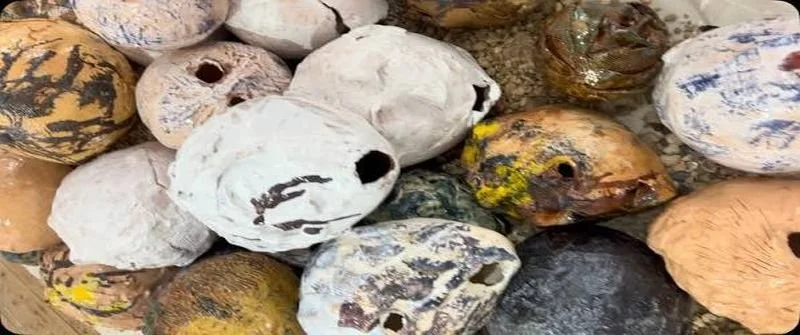
The Stones Cry out - Dorothy Morris
31st August - 9th September
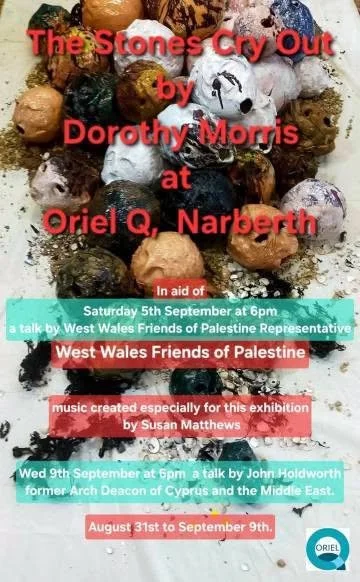
The exhibition is a response to the futility of war especially the horrendous slaughter of thousands of Palastinians in Gaza.
This exhibition hope to highlight the suffering of the Palastinians. This installation includes my artworks and music composed by Susan Matthews. Art works are for sale and 50% of all sales are in aid of West Wales Friends of Palestine who support a tent school in Gaza.
“Children are never our enemies , they are the innocent vicitms of conflict.” West Wales Friends of Palastine try to help ease their sufferings by raising funds to provide education medicine and general support. I hope this exhibition helps to spread empathy for the suffering of others and bring about action to produce peaceful resolutions to conflicts.
Dorothy’s work begins, quite naturally, at the water’s edge. Living in Ferryside, where land, river and sky are in a state of almost constant negotiation, she is deeply influenced by the particular rhythms of this coastal landscape. It is an idyllic place in which to work, certainly, but also a restless one: tides advance and retreat, light alters familiar forms, and the weather continually redraws the horizon. These shifts find their way into her work.
An experienced artist, teacher and lecturer, Dorothy has exhibited widely in selected exhibitions throughout Wales and Britain, as well as internationally, including in Russia. She holds a BA (Hons) in Fashion and Textiles and an MA in Fine Art from the Swansea Institute of Higher Education, bringing to her practice both a strong understanding of materials and a willingness to disregard the boundaries between disciplines.
Textiles, ceramics and mixed media sit comfortably alongside watercolour and acrylic. Dorothy is not especially interested in remaining faithful to a single material or process; experimentation is part of the language of the work. One material suggests another, one technique interrupts the certainty of the last, and new possibilities are continually explored.
Yet beneath this diversity there remains a constant: place. Ferryside, her home village, is more than simply a source of subject matter. Its shoreline, changing waters, weather and expansive skies provide an enduring visual vocabulary. Dorothy’s work grows from the experience of living within this landscape rather than merely looking at it — a sustained conversation between material, memory and the ever-changing edge of the sea.
Hildegard Wildebeast, art critic, visits The Stones Cry Out
Dorothy Morris — Oriel Q Gallery, Narberth
31 August–9 September 2026
There are exhibitions one enters looking for paintings, and exhibitions one enters only to discover that looking is no longer enough.
Dorothy Morris’s The Stones Cry Out, at Oriel Q Gallery in Narberth, belongs emphatically to the latter category.
The title is biblical in origin — the suggestion that when human voices are silenced, the stones themselves will testify. Morris has taken that idea and made it disturbingly literal. At the centre of the gallery lies a mound of roughly formed ceramic heads: cracked, pierced, burnt, scarred, some almost skull-like, others retaining the vulnerable roundness of a human face.
They are not portraits. That is important. They have no names.
And yet, standing before them, it becomes almost impossible to regard them simply as objects.
They resemble something excavated: archaeological remains from a catastrophe that has already happened, or perhaps evidence being assembled for some future tribunal. Their beauty — and many of them are extraordinarily beautiful as ceramic objects — creates an uncomfortable tension. Ochres, chalk whites, bruised greens, blues, blacks and scorched earth colours make the pile seductive before its implications become apparent.
Then one notices the holes.
A mouth. An eye. A wound.
Suddenly the stones have become bodies.
Behind them hangs a procession of long, ragged, apparently scorched banners. Their edges seem burnt away. Across their stained surfaces Morris has placed quotations about war and violence: Pope Francis, Jimmy Carter, Thomas Merton, Isaac Asimov, Harry Patch and others. One reads them almost as one might read inscriptions on memorial stones.
“There is no flag big enough to cover the shame of killing innocent people.”
“War is organised murder and nothing else.”
“There is no glory in battle worth the blood it costs.”
The quotations are familiar in sentiment, perhaps, but familiarity is precisely the accusation. Humanity has said these things before. We have written them, carved them into memorials, repeated them every November — and nevertheless we continue.
Morris's banners therefore do something more interesting than simply provide political slogans. Their physical deterioration contradicts the apparent permanence of their words. Wisdom is present, but ignored. The edges burn while the aphorisms survive uselessly in the centre.
The installation is explicitly Morris's response to war and to the suffering of Palestinians in Gaza. The gallery describes the exhibition as an attempt to highlight Palestinian suffering and the futility of war; 50% of artwork sales are being donated to West Wales Friends of Palestine, which supports a tent school in Gaza.
But Morris wisely does not confine the exhibition to documentary imagery.
There are paintings too, and they make the exhibition stranger.
A great flight of gulls wheels above a shoreline beneath a turbulent sky. At first it appears to offer relief — sea, air, movement, the familiar visual territory of an artist whose practice has long been shaped by living beside the water at Ferryside. Morris has worked across painting, textiles, ceramics and mixed media throughout her career, and that refusal to remain obedient to one medium is particularly effective here.
Look more closely at the beach painting, however, and the idyll is broken by a tiny human figure lying at the water's edge.
It is a devastating detail precisely because Morris does not enlarge it.
Elsewhere the mood becomes apocalyptic. Skeletons float beneath a huge moon above a burning city. The image risks theatricality — Morris is not interested in understatement here — but in the context of the ceramic heads it acquires another force. These are no longer Gothic memento mori. They become the anonymous dead, multiplied until individuality disappears.
And this question of individuality may be the exhibition's most powerful idea.
We understand one death.
We struggle to comprehend thousands.
Numbers eventually become abstractions; Morris attempts to reverse the process. Her ceramic forms return mass death to the stubborn physicality of one head, another head, another, another. Each has been handled. Each is different. Each occupies space.
There is something ancient about them. They recall burial objects, reliquaries, excavated skulls and the anonymous remains displayed in archaeological museums. Yet here the archaeological distance has collapsed. These are objects made now, about events occurring now.
That distinction matters.
The Stones Cry Out is not a neutral exhibition and makes no pretence of being one. Morris has made a work of protest, mourning and solidarity. Some viewers will inevitably approach its political position differently from others. But the exhibition asks a question that precedes politics: at what point does another person's suffering become sufficiently distant — geographically, culturally or numerically — that we permit ourselves not to see it?
The answer Morris offers is uncompromising.
Look again.
The accompanying programme extends that demand beyond the gallery. On Saturday 5 September at 6pm, a representative of West Wales Friends of Palestine will speak in connection with the exhibition. On Wednesday 9 September at 6pm, John Holdworth, former Archdeacon of Cyprus and the Middle East, will speak from his experience of the region. Music composed specifically for the exhibition by Susan Matthews also forms part of Morris's installation.
This matters because Morris does not seem interested in the increasingly comfortable contemporary idea that making an artwork about injustice is itself sufficient action. The exhibition is also a fundraiser. Artworks are being sold to generate tangible support for Palestinian charitable work.
I returned, before leaving, to the ceramic heads.
From across the room they form a crowd. Close up, the crowd disappears. There is only this one, and this one, and this one.
Perhaps that is where The Stones Cry Out is strongest.
Not in its slogans.
Not even in its anger.
But in its insistence that behind every intolerably large number is something irreducibly small: a single human life.
And when we become unable to hear those lives, Morris suggests, perhaps the stones must speak for them.
— Hildegard Wildebeast
The Stones Cry Out — Dorothy Morris
Oriel Q Gallery, 11 Market Street, Narberth
31 August–9 September 2026